
God or Multiverse?

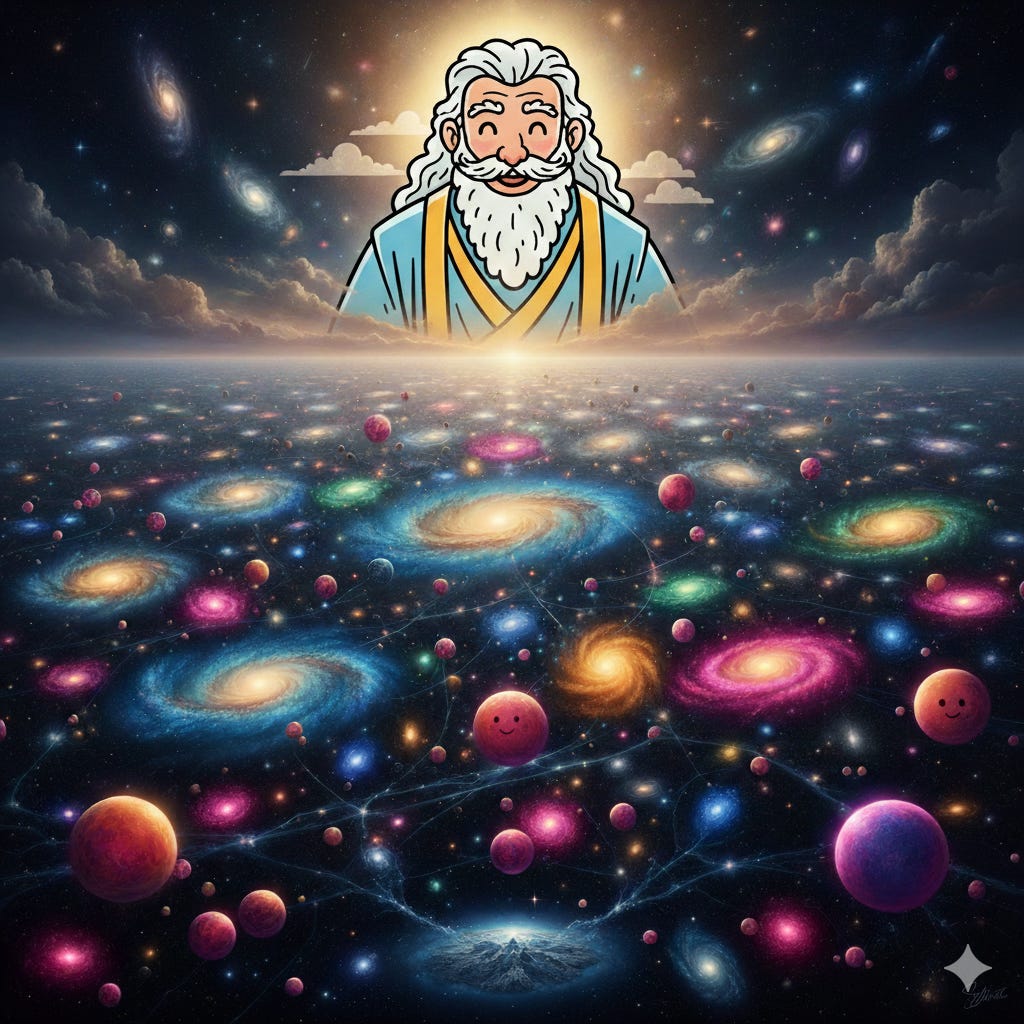
Jane was conceived through IVF. One day she discovers that the doctor who performed the IVF – Dr Clare Smith – had a strange nervous breakdown around the time. Dr Smith had been reading Jean-Paul Sartre on the absurdity of life, and had decided to express this absurdity by rolling dice to determine whether she would fertilise the egg, committing only to do so if five sixes were rolled. Dr Smith only rolled the dice once, and by a wild stroke of luck, five sixes came up. Smith subsequently got some therapy and never did this again.
Would it be rational for Jane to explain the remarkable improbability of her conception with the following hypothesis?
The Many Doctors Hypothesis – Many IVF doctors have been rolling dice to decide whether to fertilise eggs, in most cases failing to get the right numbers to proceed.
I don’t think so.
Why am I telling this silly story? Because many scientists and philosophers want to explain the fine-tuning of physics for life — the fact that, against incredible odds, our universe has the right numbers for life — by positing lots of universes. It seems to me that Jane’s situation contemplating Dr Smith’s lucky roll is relevantly similar to our situation contemplating the fact that our universe won the cosmic lottery. Therefore, if Jane’s inference to Many Doctors would be fallacious, so is the popular inference from fine-tuning to a multiverse.
There’s no getting around it. Fine-tuning needs explaining, and the only way to explain it is with something Godish. As I discuss in my Why? book (just out in paperback!), it needn’t be the very traditional God; it could be a conscious universe, or teleological laws of nature. But a multiverse won’t do the job.
Still not convinced? Check out this week’s video on my channel, which is a collaboration with Phil Halper’s channel (AKA Skydive Phil) in which Kenny Boyce and I discuss/debate with two leading multiverse theorists.
SUBSCRIBE TO MY SUBSTACK AND YOUTUBE (@PHILIPGOFFPHILOSOPHY) AND SUPPORT MY PUBLIC WORK FINANCIALLY IF YOU’RE ABLE
I think what's doing a lot of the work in the Jane case is that intuitions are being pumped by the weirdness of your situation.
Unless you posit that everyone is being made by crazy doctors, your situation is a very weird one, even if there are lots of crazy doctors. Being made by a crazy doctor is not a precondition for an existence of someone like you. Unlike fine-tuning.
So there's kind of a reference class problem. If you take the most intrinsically significant thing about your identity to be that you were made by a crazy doctor, then you might want to posit lots of crazy doctors so that somebody like you can exist. But if you take this fact about your origin to be insignficant and incidental to your identity, then you'll be inclined to disregard it and see it as something that doesn't need an explanation.
In the actual fine-tuning case, what is salient or significant is that conscious observers and life exists at all. That does not seem to be so amenable to treatment as an insigificant feature of the universe that only matters to us because it happened to take place, though some opponents of the FTA want to say so. We look at the evidence for fine-tuning, and it strikes us that this is really important. That a universe without fine-tuning would be utterly different. That this is really important and demands an explanation.
That you were made by a crazy doctor? Not so much. It's weird, but it doesn't strike us as all that significant. It doesn't demand an explanation in the same way. It's more like being born in an aeroplane, or being conceived as a consequence of your parent going on a holiday they could only afford because they won the lottery. There are all sorts of stories about how people are conceived and born, and they're all unique. Nothing about Jane really cries out for an explanation in particular. Every conception is a miracle. Jane's is no different to anybody else's.
But if Jane doesn't know if there are other humans, and if Jane thinks that humans can only be created by crazy doctors, then she may have reason to think there are many crazy doctors. Or if Jane thinks of people who are made by crazy doctors as being importantly different from regular people, as different as we are from bacteria, then she might think that there are lots of crazy doctors.
My other thoughts on this video are here: https://disagreeableme.substack.com/p/the-fine-tuning-argument-is-tough
When you say 'teleological universe', how would this fit, or not, with Lee Smolin's and Rupert Sheldrake's (as best I know independent) proposals that natural laws evolve? Does the fine tuning depend on this being a tunable instrument? And if so, do we find an example of self-tuning in homeostatic organisms?