

75% of Swedes are “Somethingists”. Somethingists don’t believe in the God of traditional religion but they believe in “Something,” i.e., some greater spiritual reality about which little can be said.*
In my experience, Somethingists tend to have a lot of time for Eastern religions, such as Buddhism or Advaita Vedanta, but think of the Abrahamic faiths (Judaism, Christianity, Islam) as having too anthropomorphic an idea of the Divine — “the Old Guy in the Sky.”
The irony is that each of the Abrahamic faiths has a mainstream form that teaches something very close to, perhaps even identical to, Somethingism. I am thinking of apophatic understandings of God, on which nothing positive can be said about God. God’s nature is beyond what can be captured in human language. It may even be too much of positive statement to say that God is “Something.”
Apophatic theology is not fringe. The mainstream understanding of the Divine in the two oldest, large Christian churches is essentially a semi-apophatic view of God. In the Western church, we find Aquinas’ view that we can speak of God but only by analogy. In the Eastern church, there is a distinction between God’s essence — which is utterly unknowable — and God’s energies — which are imminent and accessible.
The problem is we are living in a moment when the idea that God is just a kind of “Super-Mind” — a view that historically was fringe — has come to dominate, at least in the public understanding of the Abrahamic faiths. Brian Davies calls the “Super-Mind” view of God “theistic personalism,” in contrast to classical theism on which God is utterly simple and can be spoken of only by analogy if at all.
Thus we have a mixed-up, topsy-turvy world in which those we think of conservative religious people are in fact defending a radically new idea, and those we think of as rejecting traditional religions – the Somethingists – are actually harking back to the traditional idea of God.
All of this was really driven home to me by the interview I put out in my channel (Philip Goff Philosophy) this week with Catholic philosopher Tyler McNabb. We talked about Tyler’s fascinating short book Eastern Philosophy and Classical Theism, in which he argues that many Eastern religions, including some forms of Buddhism, believe in the God of classical theism.
I am becoming passionate about finding ways of communicating to the Somethingists that what the believe in is just what traditional religious people have believed in throughout history. More to follow.
PLEASE SUBSCRIBE AND SUPPORT MY PUBLIC WORK FINANCIALLY IF YOU’RE ABLE.
“Galileo’s Error” is my book on consciousness and panpsychism:
My book “Why? The Purpose of the Universe” explores the spiritual implications of panpsychism.
*I have adopted this term from the short book Semi-Secular Worldviews and the Belief in Something Beyond, by Carl-Johan Palmqvist and Francis Jonbäck. Both this book and McNabb’s book are Cambridge Elements, which is an excellent range of short academic books.
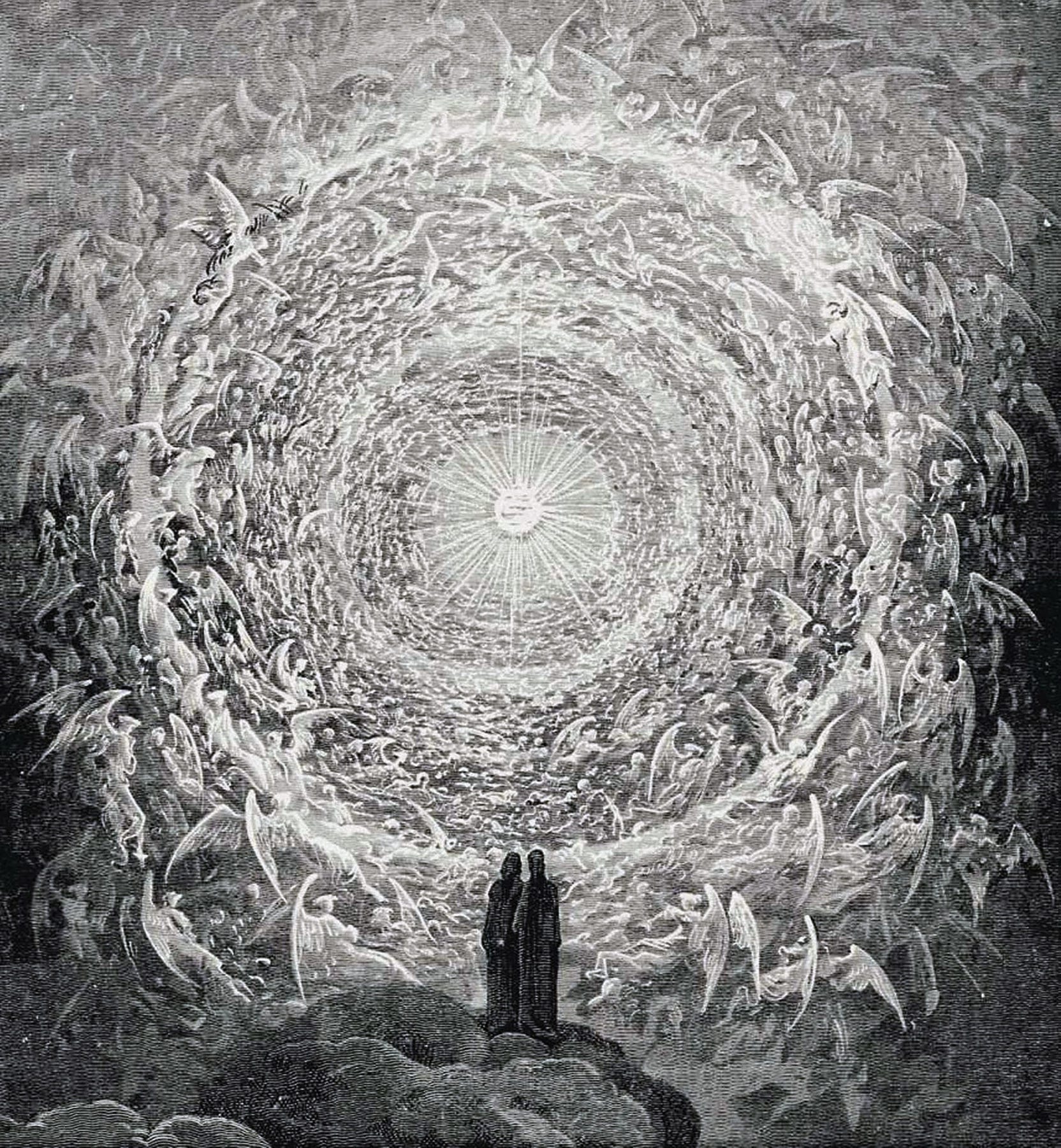
Image: Gusatave Doré - Paradiso, Canto 34 (1868)
I think the problem with apophatic definitions of God is that it becomes so vague as to become meaningless.
Many of the things classical theists say about God are compatible with my view -- that everything is grounded in mathematical structure, if we just identify God with the ensemble of all mathematical objects.
* Is not a person
* Is infinite
* Is simple (in the sense of no free parameters, for instance)
* Is beyond human understanding
* Is a necessary being
* Grounds all of existence
* The physical world is inside God (for panentheists; not quite your view where there is an overlap but neither is wholly inside the other)
* Is perfect (to the extent that such a claim is meaningful at all, which I doubt)
In order to distinguish classical theism from a view like mine I think you need to make some positive claims. Claims about morality or value, for example, like that moral/value realism is true God is the source of morality/value. Or claims that Jesus (or Buddha, or Mohammed, or whoever) is special in some God-related way.
Somethingism isn't enough.
While I think there are some intellects that think of God as a "Super-mind", I don't think most every day, traditional, followers of Christianity see the Father in that light. I think they (mostly) view him in that old man with a beard, very judgmental, kinda guy, kinda way. In other words, they see him as a being, whether flesh and blood, or not.